Engine type
A diesel engine is normally assigned a lower displacement limit than a gas engine at the same jump-starter rating. Always use the diesel column for a diesel vehicle.
September 10th , 2026 | AstroAI *
Jump Starter Buying Guide | September 10, 2026
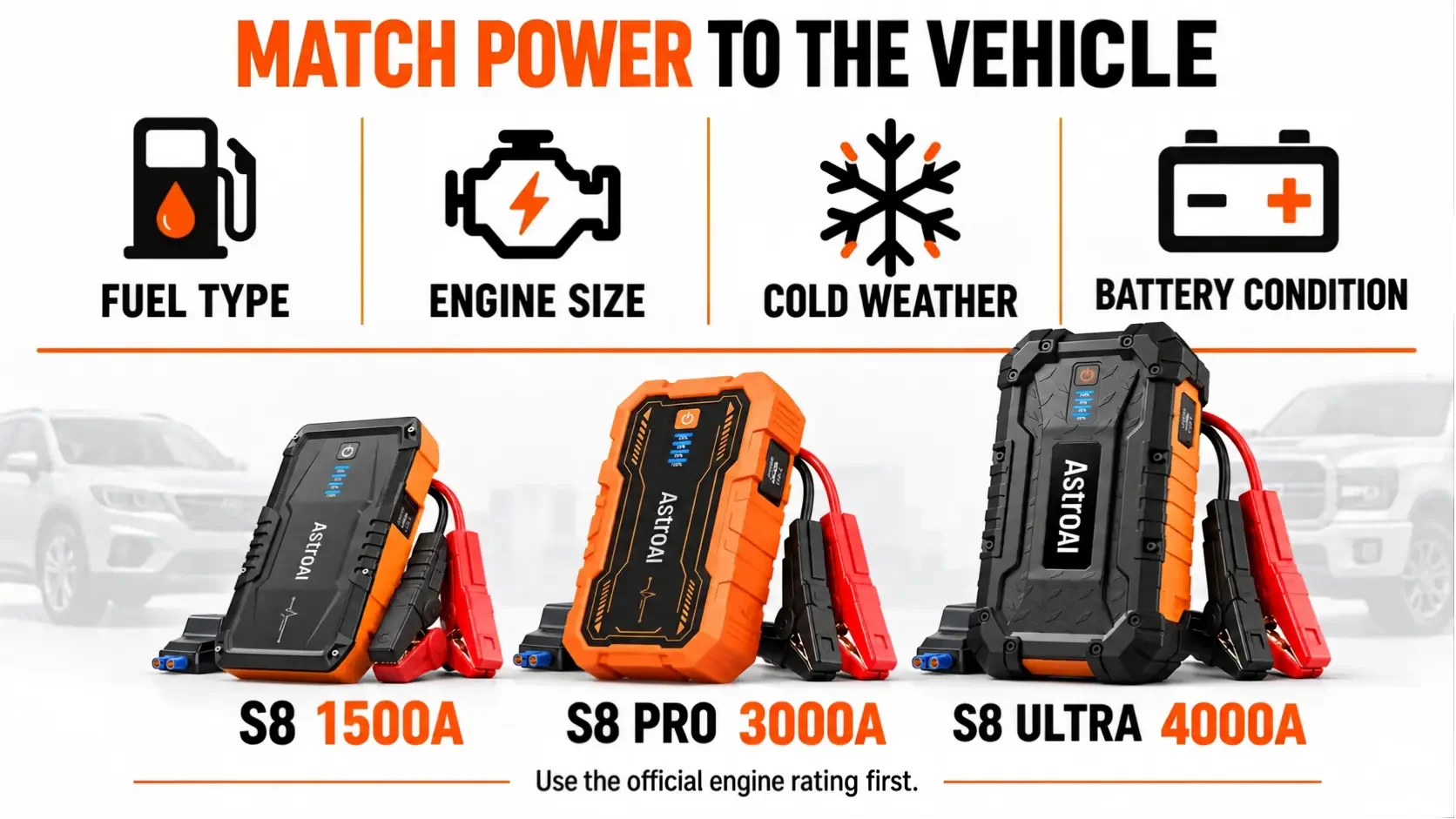
How many peak amps do you need for a jump starter? Choose a model whose official engine rating covers your vehicle's fuel type and displacement, then leave more margin when the weather is cold or the battery is deeply discharged. For example, the AstroAI S8 is rated at 1500A for engines up to 6L gas or 3L diesel, while the S8 Pro is rated at 3000A for engines up to 9L gas or 7L diesel. Peak amps alone are not a universal engine-size formula: diesel engines, larger displacement, low temperature, connection quality, and battery condition all change how demanding a start can be.
Start with engine compatibility. Match gas or diesel type and displacement to the model's published engine rating before comparing any other feature.
Add margin for harder starts. If your engine sits near a model's upper limit, the weather is cold, or the vehicle battery is very weak, move to the next compatible power tier instead of choosing the smallest qualifying unit.
Keep the jump starter ready. AstroAI manuals for the S8, S8 Pro, and S8 Ultra say the unit should be above 75% charge for best jumping performance.
The table below is a conservative selection guide built from current AstroAI engine ratings. A higher-rated model provides more headroom, but it cannot repair a damaged battery or solve a no-start condition caused by fuel, ignition, starter-motor, or vehicle-electronics faults.
Read the Rating Correctly
Peak amps describe the jump starter's maximum short-duration output rating. That number is useful for comparing models in the same lineup, but it does not tell you by itself whether a unit fits a specific engine. The more actionable specification is the manufacturer's engine rating, which already pairs the power tier with gas and diesel displacement limits.
A diesel engine is normally assigned a lower displacement limit than a gas engine at the same jump-starter rating. Always use the diesel column for a diesel vehicle.
Larger engines generally need more cranking power. Check the engine displacement in the owner's manual, vehicle specification label, or manufacturer documentation.
Cold conditions and a more deeply discharged battery make a start more demanding. Choose extra headroom rather than operating at the smallest published limit.
Engine, Weather and Battery Match
Use the first model named in each row for an ordinary low-battery start within the published engine limit. Choose the higher-headroom option when the engine is near that limit, temperatures are cold, or the vehicle battery is more deeply discharged. This is selection guidance, not a guarantee that every no-start condition can be resolved.
| Engine type and displacement | Temperature | Vehicle battery state | AstroAI starting point | Higher-headroom choice |
|---|---|---|---|---|
| Gas up to 6L | Mild | Low but otherwise serviceable | S8: 1500A Rated up to 6L gas |
S8 Pro: 3000A Rated up to 9L gas |
| Diesel up to 3L | Mild | Low but otherwise serviceable | S8: 1500A Rated up to 3L diesel |
S8 Pro: 3000A Rated up to 7L diesel |
| Gas up to 9L or diesel up to 7L | Mild to cold | Low, or smaller engine with extra margin desired | S8 Pro: 3000A Rated up to 9L gas / 7L diesel |
S8 Ultra: 4000A Rated up to 10L gas / 8L diesel |
| Gas up to 10L or diesel up to 8L | Mild to cold | Low; engine may be near the published limit | S8 Ultra: 4000A Rated up to 10L gas / 8L diesel |
S8 Ultra+: 5000A Rated for all gas / up to 10L diesel |
| All gas engines or diesel up to 10L | Mild to cold | Low; high-displacement application | S8 Ultra+: 5000A Rated for all gas / up to 10L diesel |
S8 Ultra Max: 6000A Rated for all gas / up to 12L diesel |
| Diesel over 10L and up to 12L | Within the product's allowed operating conditions | Low but not visibly damaged | S8 Ultra Max: 6000A Rated up to 12L diesel |
The S8 Ultra Max (6000A) covers the vast majority of 12V battery starting needs — including large-displacement diesel engines. No higher-rated option needed. |
Need inflation too? The S8 Air combines a 3000A jump starter with a 150 PSI inflator and is currently rated for engines up to 6L gas or 3L diesel. Choose it for the two-in-one function, not because 3000A alone changes its published engine limit.
Cold-Weather Headroom
Cold weather can make the vehicle harder to crank while also reducing the immediately available output of battery-powered equipment. That is why a model that barely covers the engine on paper is not the most conservative cold-weather choice. The published operating-temperature range for the S8, S8 Pro, and S8 Ultra is -4°F to 122°F (-20°C to 50°C); this is an allowed operating range, not a promise that every battery and engine will start anywhere within it.
Three Clear Starting Points
S8 Pro is the main recommendation for drivers who want broad passenger-vehicle, SUV, and van coverage without moving immediately to the higher output tier. S8 suits smaller engines and lighter carry, while S8 Ultra expands the published engine range for larger 12V applications.
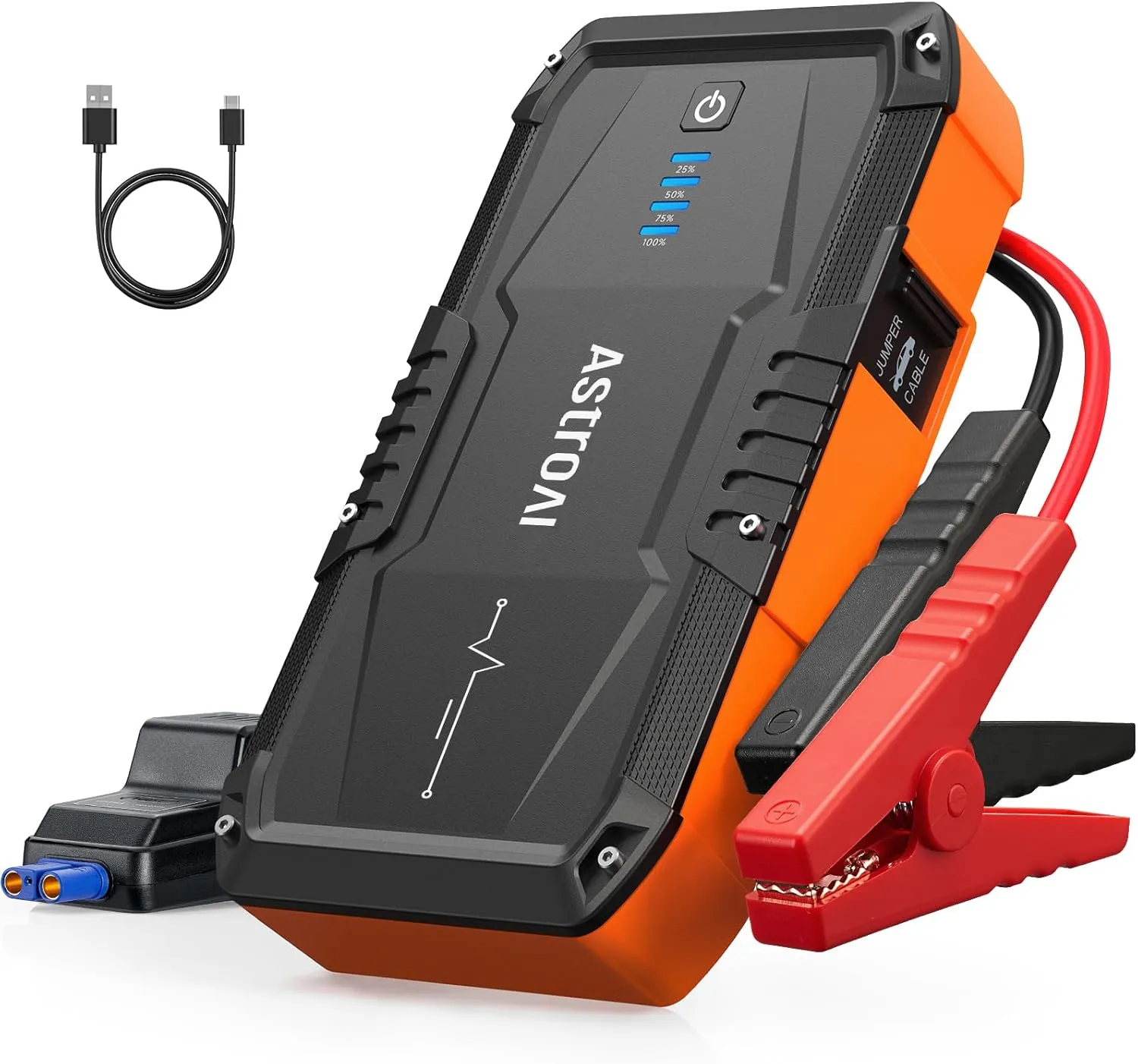
Compact starting point
Verified fit: 1500A; up to 6L gas or 3L diesel engines.
Best for: motorcycles and passenger vehicles comfortably inside those engine limits.
Pros: compact 1500A starting point. Cons: less headroom than higher S8 tiers.
Choose another model when: the engine sits near the limit and regular cold-weather or deeply discharged starts are a concern.
View S8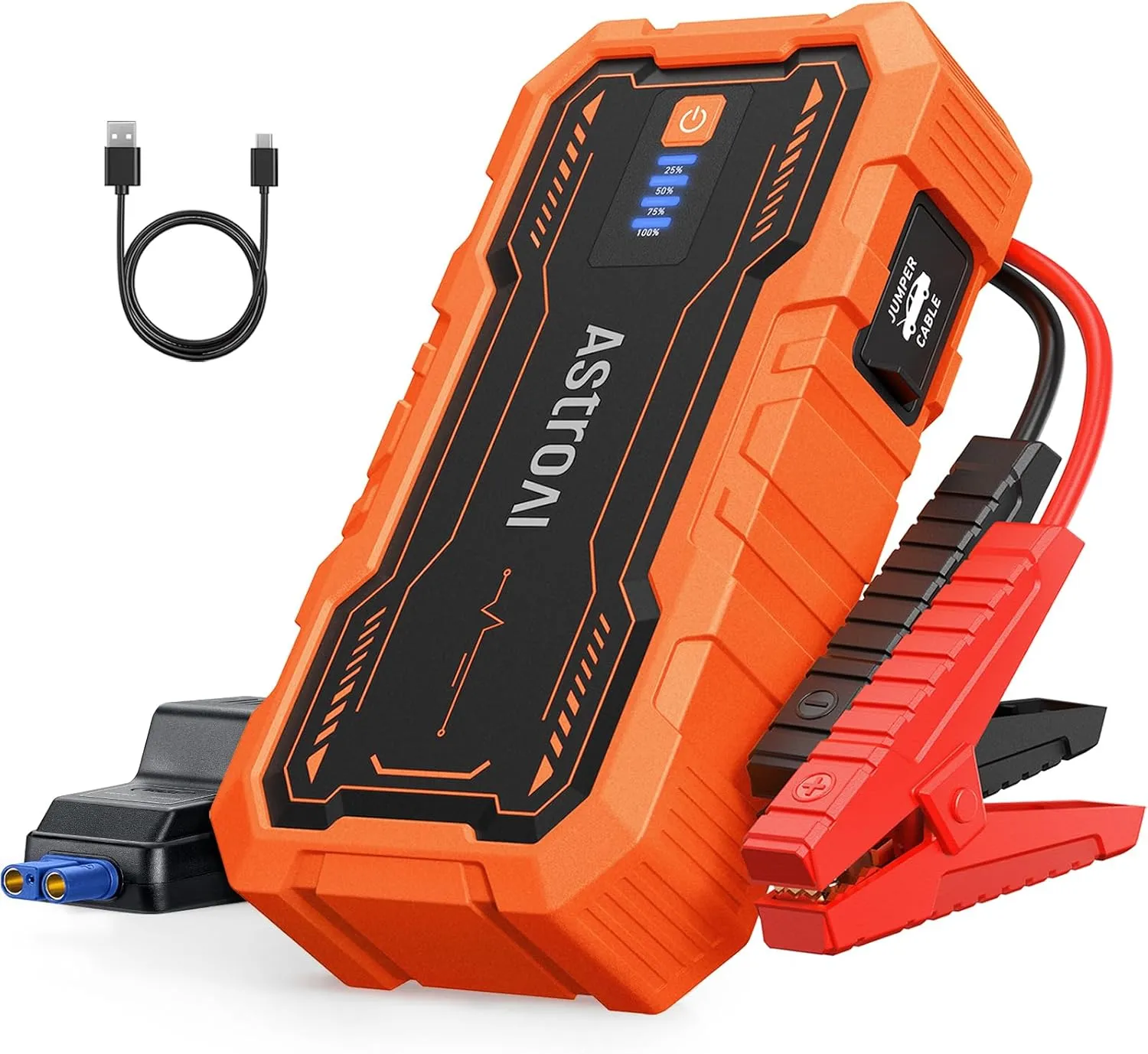
Main recommendation
Verified fit: 3000A; up to 9L gas or 7L diesel engines.
Best for: drivers who want a broad compatibility buffer across passenger cars, SUVs, vans, and other supported 12V vehicles.
Pros: broad 9L gas / 7L diesel rating. Cons: no built-in tire inflator.
Tradeoff: it is a dedicated jump starter and power bank, not a tire inflator.
View S8 Pro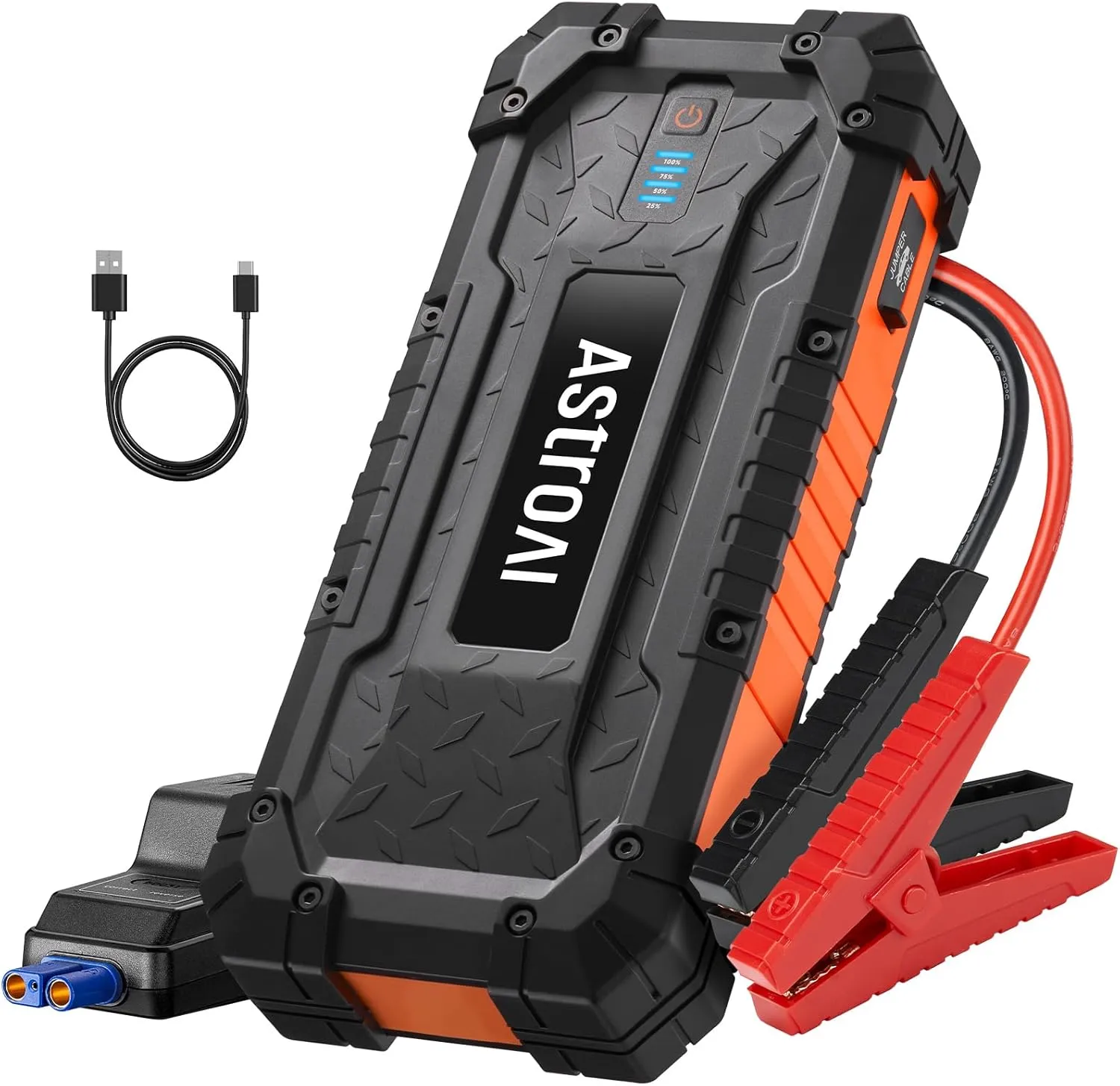
Higher-output option
Verified fit: 4000A; gas engines up to 10L or diesel engines up to 8L.
Best for: larger 12V gas and diesel applications that exceed the S8 Pro's published engine limits.
Pros: broader 10L gas / 8L diesel rating. Cons: no built-in tire inflator.
Skip it when: S8 Pro already provides comfortable engine and cold-weather headroom.
View S8 UltraBefore You Turn the Key
Always follow the manual for your exact model. The sequence below reflects the shared instructions in the official S8, S8 Pro, and S8 Ultra manuals.
Verify that the vehicle uses a 12V system and that the engine type and displacement are within the selected model's published rating.
For best jumping performance, make sure the jump starter is above 75% charge and switch off electrical devices inside the vehicle.
Clean dirty battery terminals and do not use damaged clamps or cables. Fully insert the smart-clamp plug into the jump starter.
Connect red to the positive terminal and black to the negative terminal. Continue only when the clamp indicator shows the status specified by the manual.
Start the engine, then remove the clamps after a successful start. If another attempt is needed, follow the exact wait-time and indicator instructions for your model.
Do not hunt for one universal amp number. Match the official engine rating first, then choose additional headroom for cold conditions, a battery that is more deeply discharged, or an engine close to the model's limit. For broad everyday 12V coverage, the 3000A S8 Pro is the balanced starting point in this lineup; step down to S8 for smaller engines or up through S8 Ultra, S8 Ultra+, and S8 Ultra Max as the published engine limits require.
Choose by the manufacturer's engine rating, not by a universal peak-amp formula. Within the current AstroAI lineup, S8 is rated at 1500A for up to 6L gas or 3L diesel, while S8 Pro is rated at 3000A for up to 9L gas or 7L diesel. Move to a higher compatible tier when the engine is near the limit, conditions are cold, or the battery is more deeply discharged.
Engine layout alone is not enough to decide. Check fuel type and displacement. The AstroAI S8 is rated up to 6L gas or 3L diesel; if the V8 exceeds the applicable limit or operates in more demanding conditions, choose a higher-rated model.
Use the diesel-specific engine rating because it is usually lower than the gas rating for the same AstroAI model. For example, S8 Pro is rated up to 9L gas but 7L diesel, so a diesel vehicle should be matched to the 7L limit.
Extra headroom is sensible when temperatures are cold, especially if the engine is close to the model's published limit or the vehicle battery is deeply discharged. Stay within the jump starter's stated operating-temperature range and keep the unit charged as directed.
A higher peak-amp rating does not mean the unit continuously forces that current into the starter. Use only a model that the manufacturer lists as compatible with the vehicle's 12V system, follow the exact clamp procedure, and never bypass the manual's warnings.
No. The AstroAI S8 Ultra Max is rated for 12V applications with all gas engines or diesel engines up to 12L. It is not a universal solution for non-12V vehicles, engines beyond the published diesel limit, damaged batteries, or no-start faults unrelated to battery power.
Start with S8 Pro for broad everyday coverage, choose S8 for smaller engines and compact storage, or move to S8 Ultra for larger engines within its published 10L gas / 8L diesel limits.