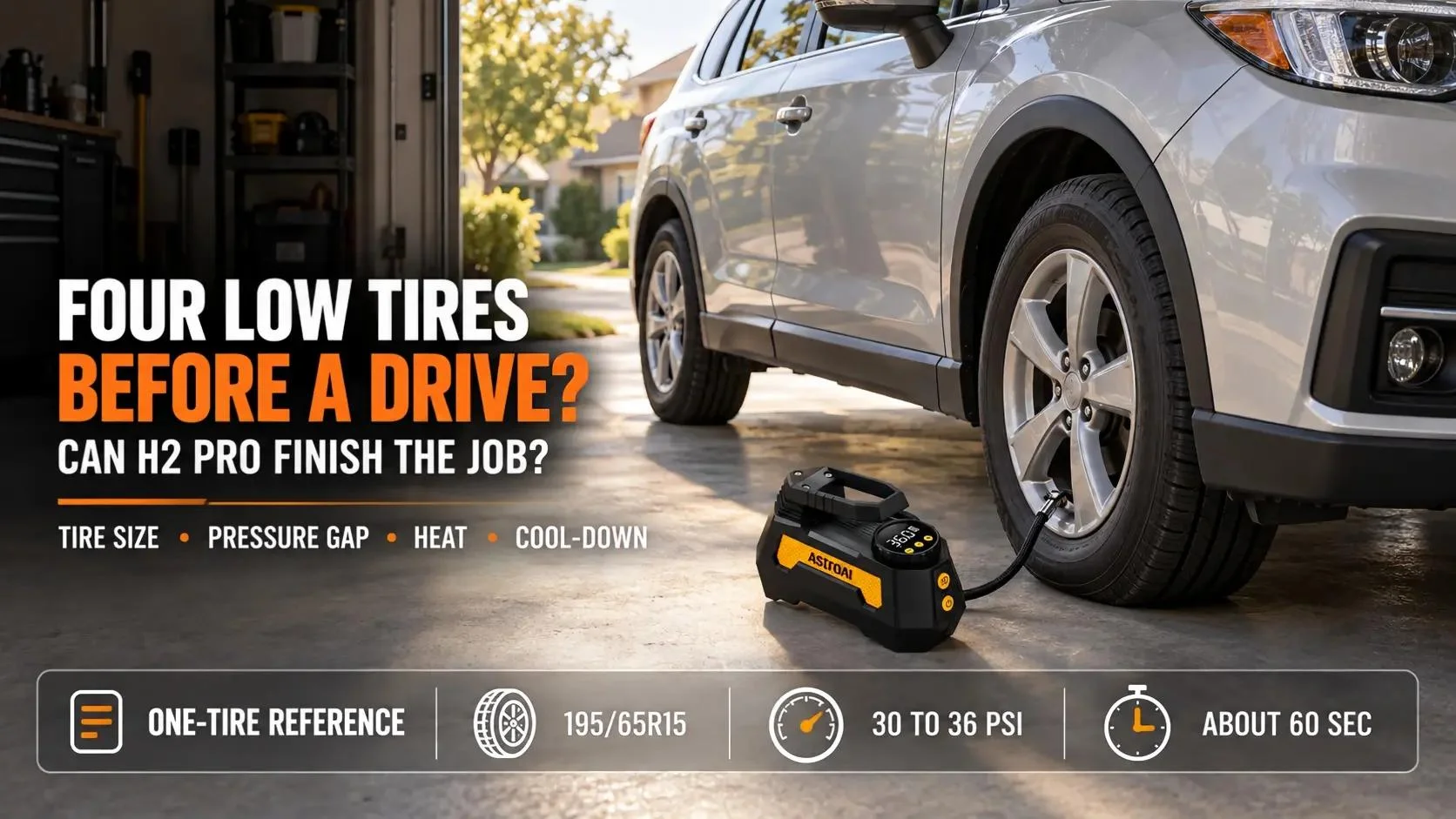
Four Low Tires Before a Drive: Can H2 Pro Finish the Job?
You check one tire before heading out. It needs a little air. So does the next one—and by the time you reach the other side of the car, your quick check has become a four-tire job. With a portable inflator in hand, the question is practical: can you finish and leave, or will you be waiting for the pump to cool?
Four modest passenger-car top-offs are a sensible job for H2 Pro. The amount of air missing matters more than the tire count alone. To judge how the session might go, start with the pressure gap, then pay attention to the pump as you move around the car.
Key Takeaway: A small correction at every corner can be a short job. A large pressure loss changes the workload—and plugging into DC power does not make heat disappear.
The tire count is only half the story
Think about two mornings. On one, every tire is a little below the recommended pressure. On the other, three tires look fine and one is far lower than the rest. The second car may have fewer tires to inflate, yet it can ask much more of the compressor. A tire that keeps losing air also needs attention beyond another top-off.
That is why “Can it do four tires?” needs a little context. The same pressure increase takes more air in a larger tire. A deeper pressure loss adds work. And the pressure you choose should come from the vehicle placard or owner's manual, rather than the maximum printed on the tire sidewall.
A one-minute top-off—and the time around it
Here is a useful starting point: the H2 Pro timing example takes a 195/65R15 tire from 30 to 36 PSI in about 60 seconds. That gives you a sense of a modest passenger-tire correction. It does not describe filling a nearly flat tire or working on a much larger tire.
Apply that same workload to four tires and the arithmetic gives about four minutes of compressor time. Your driveway clock keeps running while you disconnect the hose, walk to the next wheel, attach the chuck, and check the reading. Those everyday movements explain why a “four-minute” estimate is not an exact departure time.
This estimate extends one single-tire benchmark; it is not a measured four-tire test. Use it to picture the scale of the job. Your own tire size, starting pressure, temperature, and power condition determine how closely the session resembles it.
By the third tire, listen as well as look
The display tells you how the pressure is progressing. The rest of the pump tells you how the session is going. While moving the hose, notice whether inflation has become noticeably slower, the sound has changed, or the housing and hose seem unusually hot. If something changes, pause and check before starting the next tire.
You already have a natural break at every wheel: the motor stops, the reading settles, and you move the connection. Use that moment. It is useful observation time, although a brief valve change is not the same as letting the pump cool after a long run.
1. Inflate to the selected pressure
2. Stop and check the reading
3. Move the hose and check the pump
4. Continue—or pause to cool
H2 Pro's manual calls for at least 10 minutes of rest after prolonged use. It does not prescribe a full cooling break after every tire. If the unit becomes excessively hot or its performance changes, stop sooner; finishing the last corner can wait.
Would plugging it in solve the waiting?
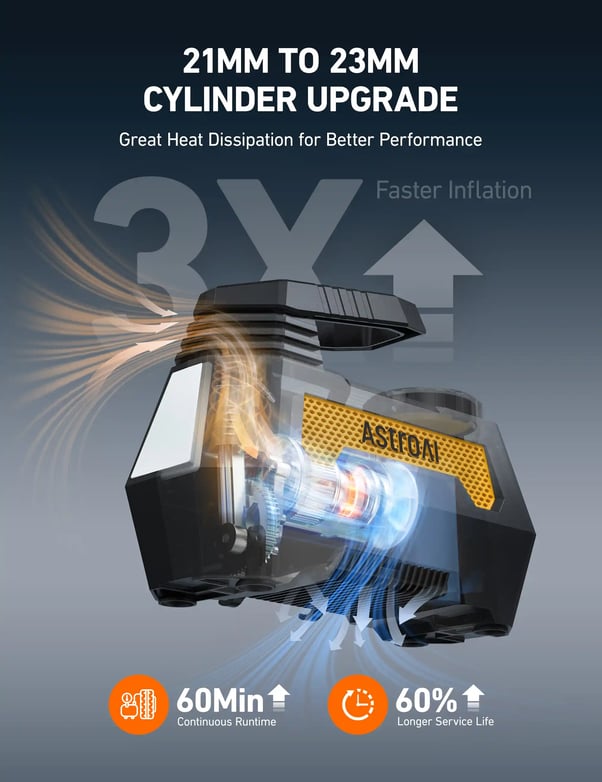
DC power helps when stored battery energy is the concern. It does not take heat out of the compressor. That distinction matters when you see different runtime figures on the same product and wonder which one tells you how long you can keep going.
H2 Pro lists 18 minutes of battery life and a 60-minute maximum working time in DC mode. The first describes battery operation; the second applies to operation from the vehicle's DC supply. The instruction to rest after prolonged use still matters alongside both figures.
For a small walk-around job, cordless operation is convenient because you can move freely between wheels. For a longer session, the DC 12V option gives you another power source. Choose the connection that suits the job, then keep watching how the pump operates. Neither runtime number promises an uninterrupted session in every condition.
AstroAI H2 Pro Tire Inflator
For this kind of routine upkeep, cordless power makes it easy to move around the car, while the DC 12V cord gives you a backup when the job runs longer than expected. Preset shutoff helps you work toward the selected pressure. Between tires, check the pump before continuing.
Best for: routine car and compatible SUV tire-pressure corrections where cordless positioning and DC 12V backup are both useful.
- 23 L/min listed inflation speed and 150 PSI maximum working pressure
- Battery and DC 12V power options
- 18-minute listed battery life and 60-minute maximum working time in DC mode
- 1.8 ft (0.55 m) inflation hose and 9.8 ft (3 m) power cord
- Pressure preset, automatic shutoff, four display units, and integrated accessory storage
Pros: dual power lets a short four-tire walk-around begin cordlessly while preserving DC as a backup for a longer session; preset shutoff and integrated storage simplify routine use.
Cons: H2 Pro is still a compact 23 L/min inflator, so higher-volume or deeper-pressure jobs can require more time and cooling awareness.
Not best for: repeated recovery of large truck, RV, dually, or oversized off-road tires, or any tire with visible damage or rapid pressure loss.
View AstroAI H2 Pro
Curious how it performs on your car?
The most useful log is the one that answers a question you actually have: does the last tire take longer than the first, and did you need a cooling break? A few notes on your phone are enough to make the next check easier to compare.
Before starting, record the tire size, outdoor temperature, power mode, and battery or supply condition. Measure the tires cold and write down each starting pressure and the vehicle's recommended target. Equal starting and target pressures make the runs easier to compare; if they differ, keep the real readings rather than forcing the session to fit an example.
For each wheel, note when the motor starts and stops, the settled pressure, and anything you notice about speed, sound, or heat. Record hose changes and cooling separately. That tells you whether a longer session came from actual pumping, moving between wheels, or waiting for the unit to cool.
If all four tires finish without an extra break, that is a useful result for that session. Keep the conditions with it. A different tire size, a larger pressure drop, or a different outdoor temperature may give you a different afternoon.
Ready to put the pump away?
After a routine top-off, the useful outcome is four tires at the vehicle's recommended pressure and a pump that has been allowed to cool as needed. You do not need every wheel to match a stopwatch.
H2 Pro fits this kind of everyday upkeep: carry it around the car, use the pressure preset, and choose battery or DC power to suit the session. Let the size of the job and the pump's behavior set the pace.
Explore AstroAI H2 Pro
A few questions before your next tire check
Can H2 Pro inflate four tires in one session?
A small top-off on four passenger-car tires is a suitable H2 Pro use case. Whether your session needs a cooling break depends on the tire size, pressure loss, power condition, and how the pump behaves as you work. A single-tire timing example does not establish a guaranteed four-tire completion time.
How long could four small top-offs take?
The H2 Pro example uses a 195/65R15 tire inflated from 30 to 36 PSI in about 60 seconds. Four equal jobs would add up to about four minutes of pump time by arithmetic, before connecting the hose, checking pressure, or cooling. That is a planning estimate, not a measured four-tire result.
What does duty cycle mean for a portable inflator?
Duty cycle concerns how running time and rest fit together. For H2 Pro, the manual lists a 60-minute maximum working time in DC mode and at least 10 minutes of rest after prolonged use. Read those instructions together; the maximum is not a reason to ignore heat.
Does H2 Pro need a cooling break after every tire?
The manual does not require a fixed cooling break after every tire. Use the changeover to check operation, and stop sooner if heat becomes excessive or performance changes. After prolonged use, allow at least 10 minutes of rest.
Should I use battery or DC power for four tires?
Battery power makes moving around the car easier, while DC 12V power avoids using up the inflator's stored battery. Neither option removes the need to watch for heat. For a timing comparison, keep the power mode consistent.
What makes a four-tire runtime log useful?
Record tire size, each starting and target pressure, outdoor temperature, power mode, and battery or supply condition. Keep each tire's pump time separate from hose changes and cooling breaks, and note settled pressures and changes in sound, speed, or heat. Report the outcome only for those conditions.